

Let’s take a quick look at Hofstede’s framework of cultural dimensions – this time with China, Germany, and the US in focus. All hugely significant and well-known nations. I have only spent longer in the US but have collaborated and been involved with many representatives of the other two at work and within educational institutions. That said, we know well that any experience and knowledge about other countries is greatly superficial and limited.
What do the components say? 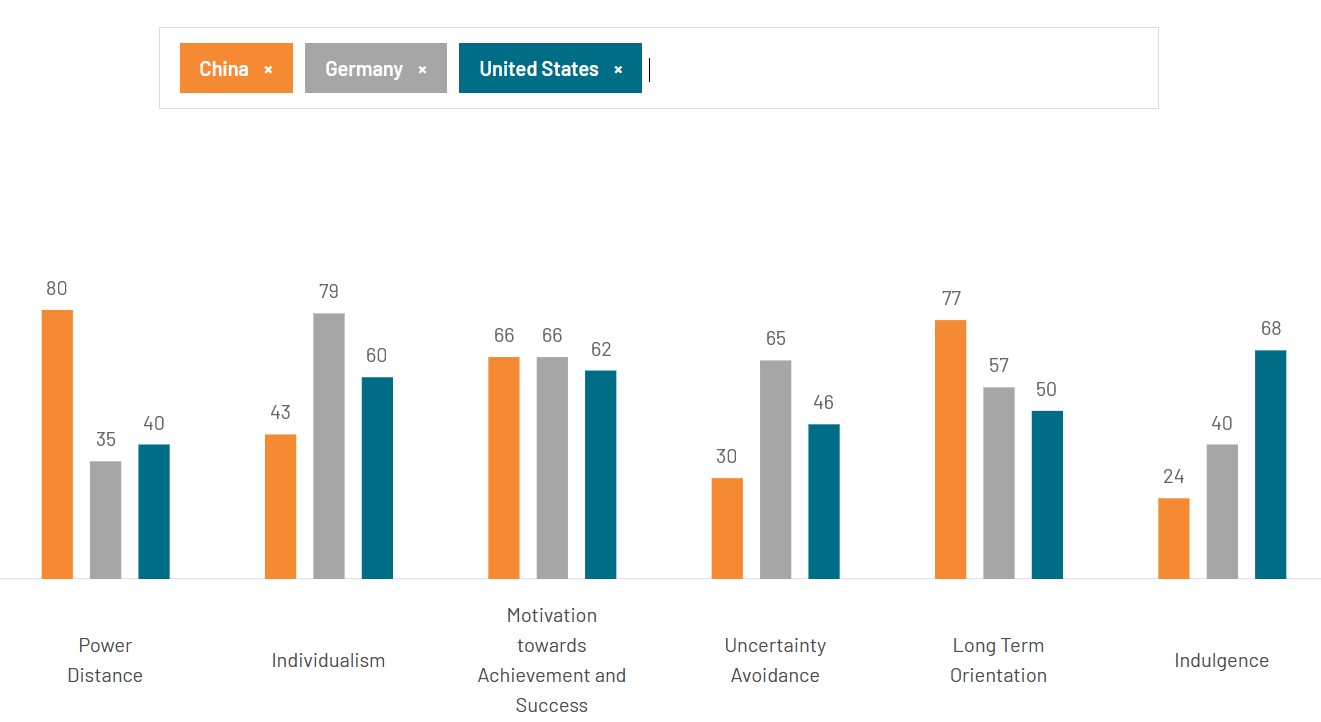 (source: https://www.theculturefactor.com/country-comparison-tool?countries=china%2Cgermany%2Cunited+states)
Why not begin with Indulgence – the dimension that reveal how much a culture tolerates free expression of one’s emotions, joy, and impulsivity. No wonder, Americans score nearly double that of Germans and a great deal more than contributors from China. Our direct experience may not even go against this finding as both Europeans and Asians are often dumbfounded by the daring assertiveness and extroversion of Americans in public places, at customer service, and during competitions.
If our inquiry is into whether the German or the Chinese diaspora has made faster progress socially and economically during their emigration into the New World, once again the answer is quick to come. If unsure, take a sudden glance at the orange bar of the Long Time Orientation component. Their 20 point advantage over Germany and 27 point advantage ahead of the States may also explain how the Asian nation has been able to produce an average of nearly 9% yearly growth in GDP since 1980. We know that it required the long-term investment of millions, making sacrifices for a more prosperous future.
A valid question is whether there are any values and characteristics that all three economic top predators share.
Even though individualism is way higher in Germany than sentiments of a collective identity characteristic of China, in the area of Masculinity / Task Orientation one can observe a shocking similarity between the three Big Cats. We have knowledge of how America’s corporate culture and career prospects are measured by competitive success and performance.
In the case of China and Germany, it might be social norms and culture itself that positions these two nations from Europe and Asia at even higher levels than their overseas competitor and partner.
(To give some context, the Comparison Tool typically places wealthy nations and welfare states lower on the Task Orientation indicator: Denmark is at 16, Sweden at a mere; 5 in contrast with Serbia: 43, and the similarly undervalued Greece: 57.) In the area of commitment to work and tasks, therefore, the top three economies are equally strong but they fall behind other notoriously consciencious nations noticeably committed to work excellence: Austria: 79, Japan: 95, Switzerland: 70).